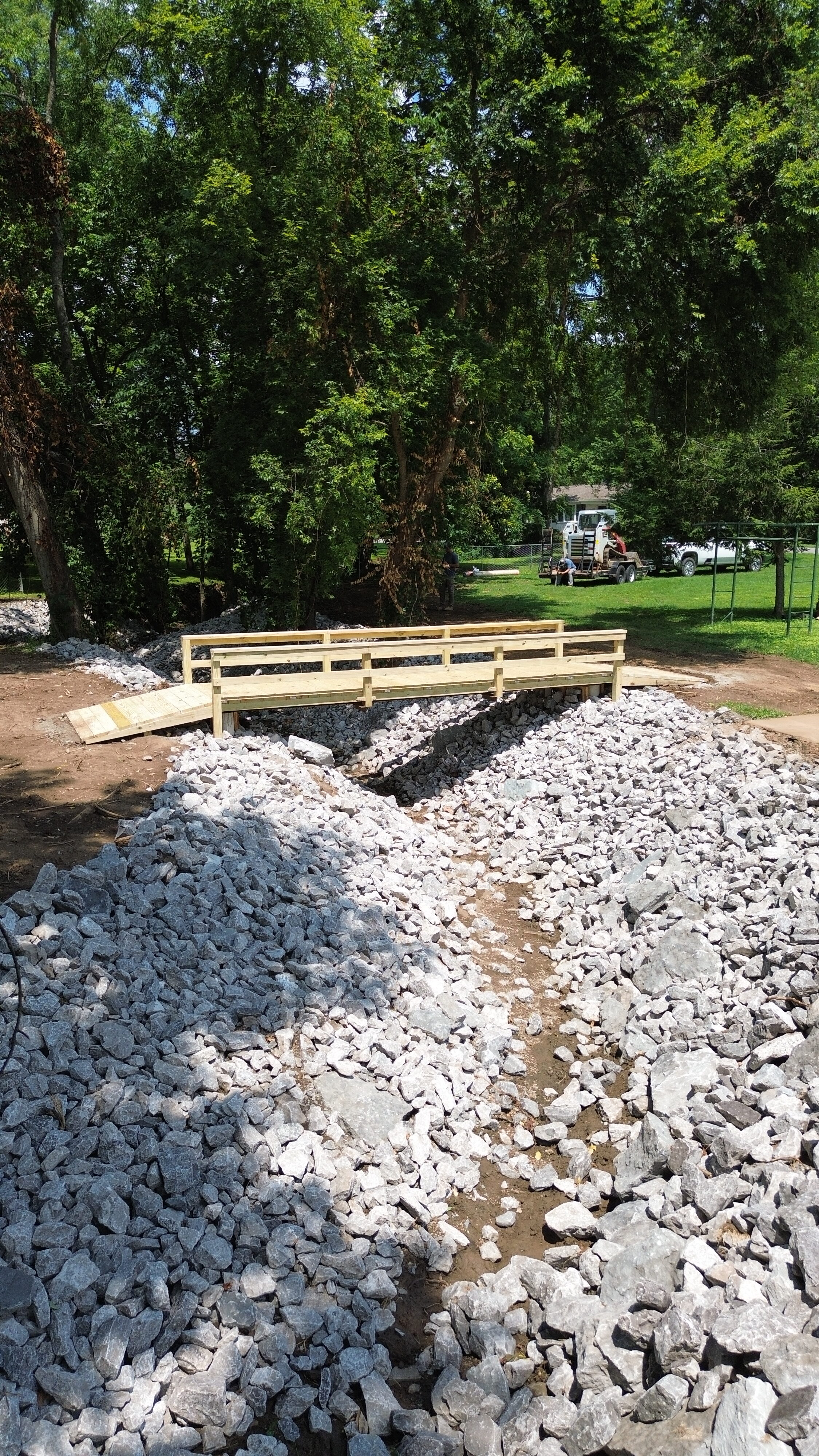
The Problem
This Nashville property had a severe, long-running erosion and drainage problem along the back of the lot. Water was concentrating and moving through a natural low channel between the tree line and the lawn — fast enough to strip topsoil, undercut the ground cover, and leave a deepening gully that grew worse every storm season. The homeowner had watched it deteriorate for years. By the time we walked the property, the channel was well-defined and actively eroding with every significant rain event.
The property also needed a crossing point over the channel — access from the lawn to the back of the lot required either walking the long way around or crossing the drainage path, which had become muddy, unstable, and increasingly unusable after rain.
What We Did
The solution had two components that had to work together: stop the active erosion in the channel, and give the homeowner a safe, durable crossing point over it.
Riprap channel installation. We excavated the existing eroded channel to a consistent profile, installed geotextile filter fabric across the full channel bed and sides, and then armored the entire channel with angular riprap rock. The riprap — installed to proper depth over the fabric — absorbs the energy of water flowing through the channel at storm volumes. It prevents the water from picking up and carrying soil particles, stopping the erosion process at its source. The geotextile fabric underneath keeps the riprap stable over time and prevents fine soil from migrating up through the rock.
Pressure-treated bridge. Once the channel was stable and properly armored, we framed and built a custom pressure-treated lumber bridge crossing over it. The bridge gives clean, dry access across the drainage channel year-round — no more walking around or getting stuck in mud after rain. It's built over the riprap channel to allow full water flow underneath during storm events.
Drone Footage — Completed Project
Photos
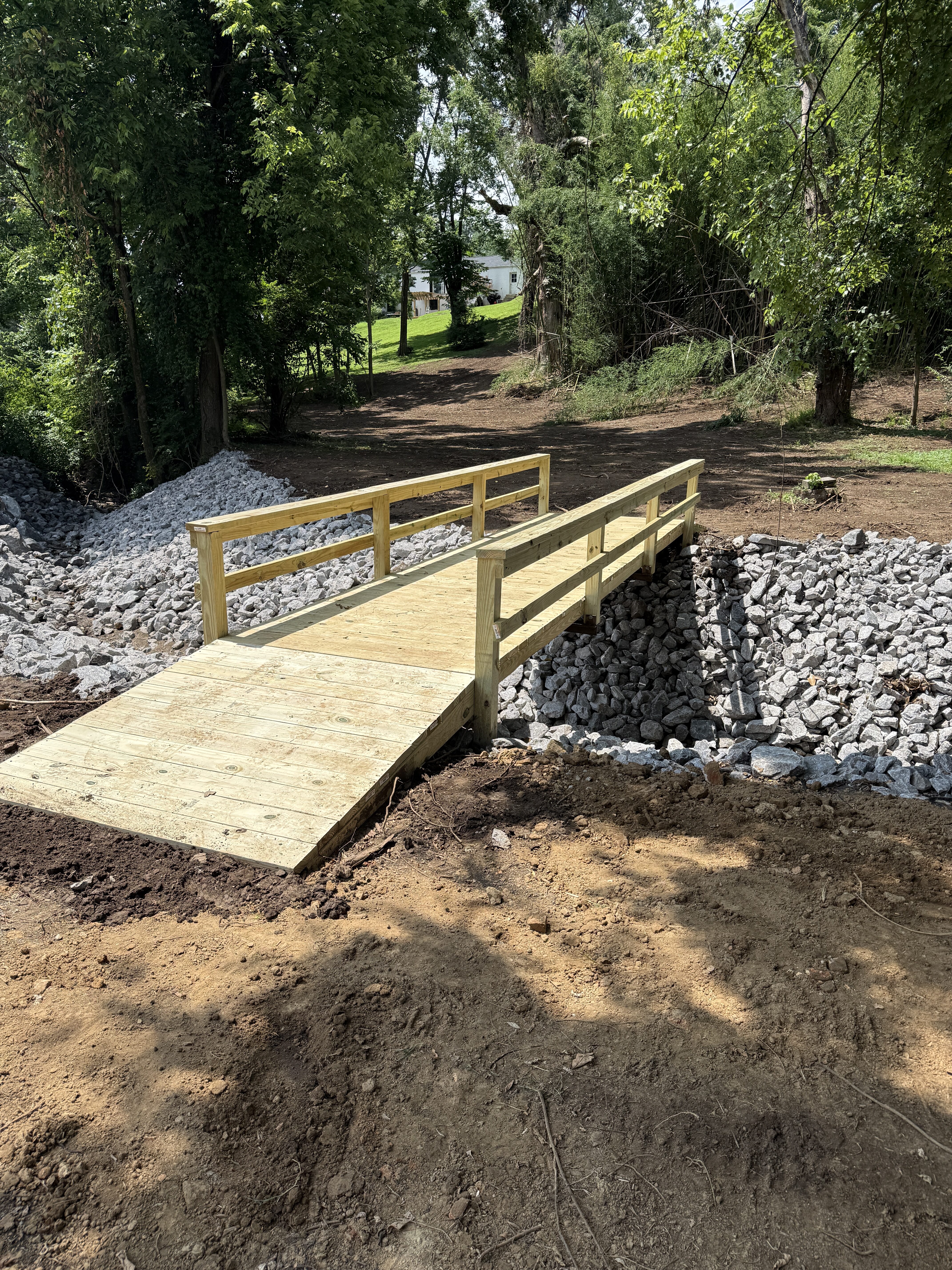
Ground-level view of the finished bridge and riprap channel
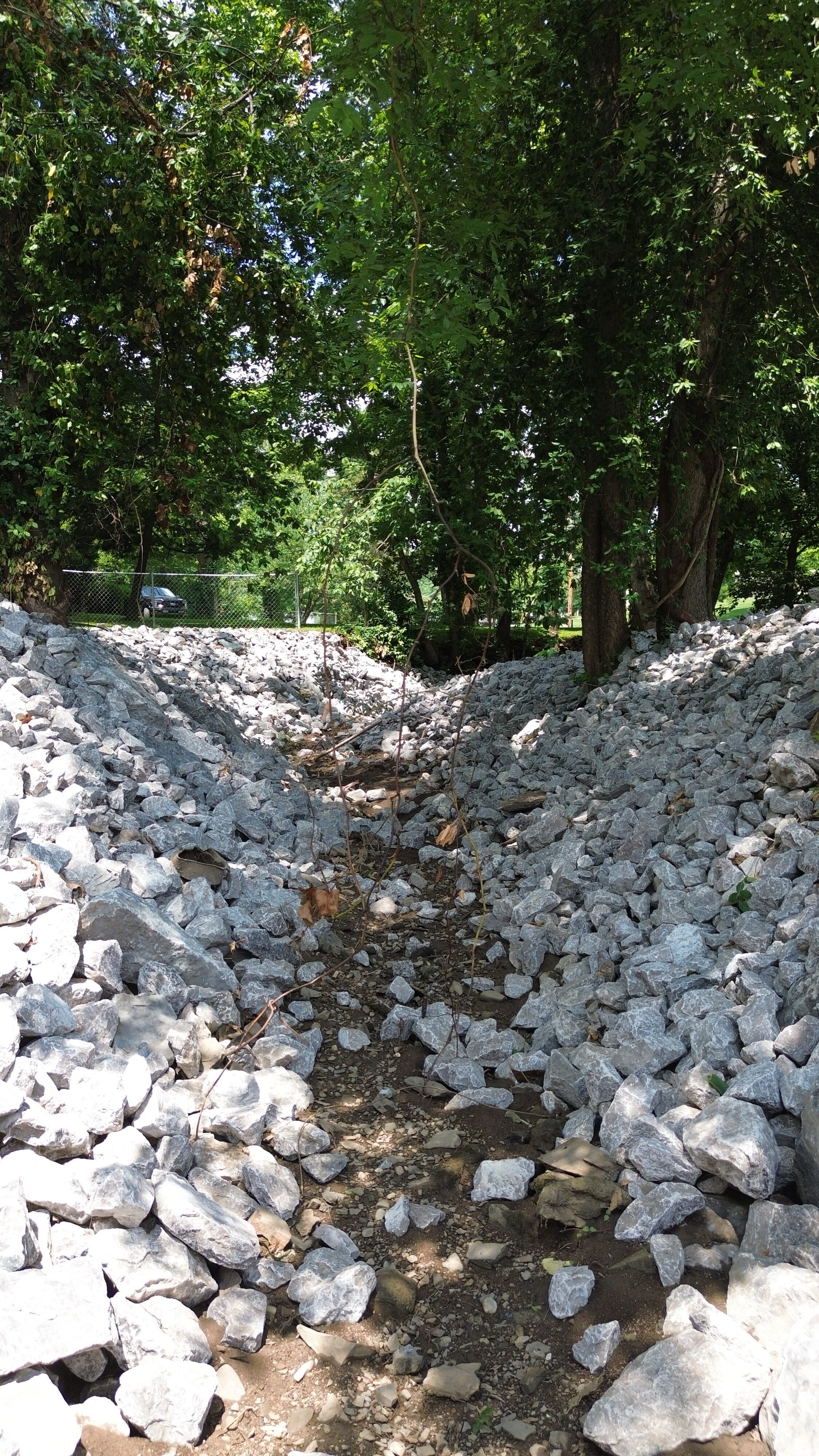
Close aerial showing riprap armor density and bridge framing
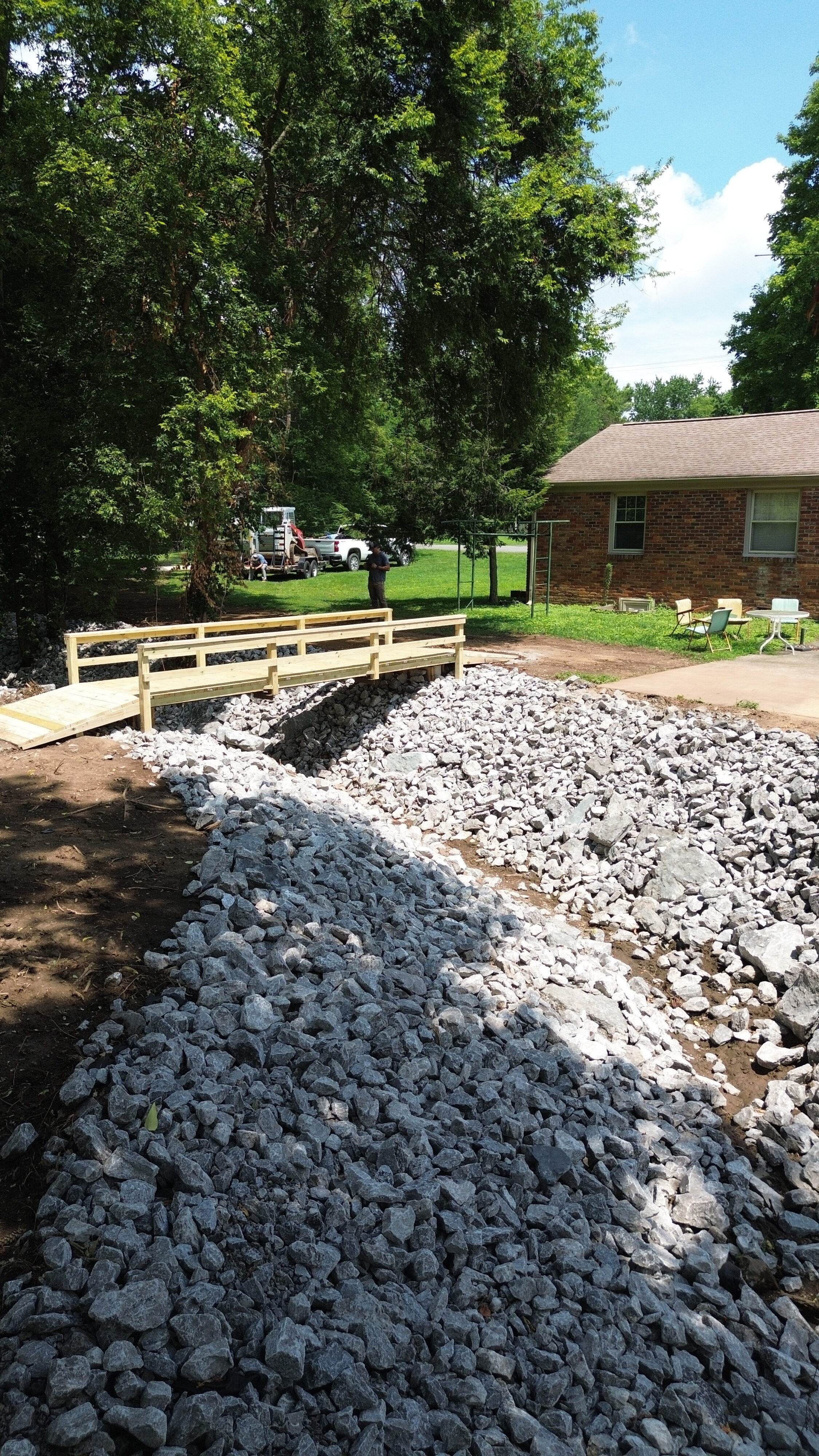
Wide aerial showing the full riprap channel run, bridge crossing, and property context
Class B Base + Class A Finish — Why This Combination Works
This job used a two-layer riprap system that's less common on residential work but makes a significant difference in both performance and appearance. Understanding the difference between Class A and Class B riprap explains why.
Class B riprap consists of large angular rock — typically 2 to 3 feet in diameter. It's heavy, it locks together, and it's designed for high-energy applications where water volume and velocity are substantial. Class B forms the structural foundation of the channel: it absorbs the peak storm energy and provides the mass that prevents displacement. This is what keeps the channel from washing out during the highest-flow events.
Class A riprap is smaller stone — 6 inches and under. Placed on top of the Class B base, it fills the voids between the larger rock, creates a tighter, more uniform surface, and gives the finished channel a clean, intentional appearance rather than the raw, jagged look of large stone alone. It also improves the hydraulic performance of the channel by reducing turbulence at the surface.
The result is a channel that performs like heavy-duty infrastructure at peak storm flow and looks finished and professional year-round. The geotextile filter fabric underneath both layers keeps the system stable over time — preventing fine soil from migrating up through the rock and undermining the installation from below.
Done correctly, this two-layer system requires essentially zero maintenance and will last for decades. It's the same approach used in commercial and municipal drainage infrastructure, applied at the residential scale.
Bridge design note: The bridge framing was sized and positioned to allow unobstructed flow through the riprap channel below during storm events. A crossing that constricts flow at a drainage channel can back water up and worsen upstream erosion — the geometry of the bridge opening relative to the channel cross-section matters.
Similar Problems We Fix
- Eroding drainage channels — any natural or constructed swale that's losing soil to water flow
- Exposed slopes — steep grades that shed water too fast for vegetation to survive
- Driveway edges washing out — concentrated flow stripping the shoulder of gravel or asphalt drives
- Culvert outfall erosion — the area immediately downstream of a culvert outlet, which takes the full force of concentrated flow
- Foundation-adjacent channels — erosion paths that are migrating toward a home's foundation or crawlspace