 Dunnebacke Constructors
Excavation · Drainage · Erosion Control · Middle TN
Free Estimates · Call Now
(615) 887-1194
Dunnebacke Constructors
Excavation · Drainage · Erosion Control · Middle TN
This pond wouldn't hold water. We cut 2 feet of soil out of the entire bottom, removed about 18 inches of rock across roughly a third of the pond, and rebuilt it with red dirt so it holds. The city also required sediment forebays at the inlets, so we built three of them with gabion baskets and rip rap, then seeded and strawed everything we disturbed.
A pond that leaks is almost always a bottom problem. Water finds the path of least resistance, and around Lebanon that path is often rock. Wilson County sits on shallow limestone, and where a pond bottom is cut down into fractured rock or thin, sandy soil over it, water seeps out through the seams faster than rain can fill it back up.
That's what we were dealing with here. Patching one spot wasn't going to fix it — the bottom as a whole wasn't built to hold water, and part of it was sitting on rock.
We excavated 2 feet of soil from across the whole pond — not just the spot that looked wet. The material that was there wasn't holding water, so it had to come out to get down to something we could build on.
Across about a third of the pond, that cut ran into rock. We removed roughly 18 inches of it. Rock under a pond is exactly where the water escapes, and you can't seal over it with a thin skim of dirt — there has to be room for a real layer of good material on top.
We brought in red dirt — the heavy, clay-rich red subsoil Middle Tennessee is known for — and rebuilt the pond bottom with it. That tight clay is what lets a pond hold water instead of draining into the rock below.
The city required forebays at the inlets. We built three, each with gabion baskets — heavy wire cages filled with stone — forming a stone wall across the inlet area, with rip rap (sometimes called gabion stone) armoring the channel. Everything disturbed around them was seeded and strawed.
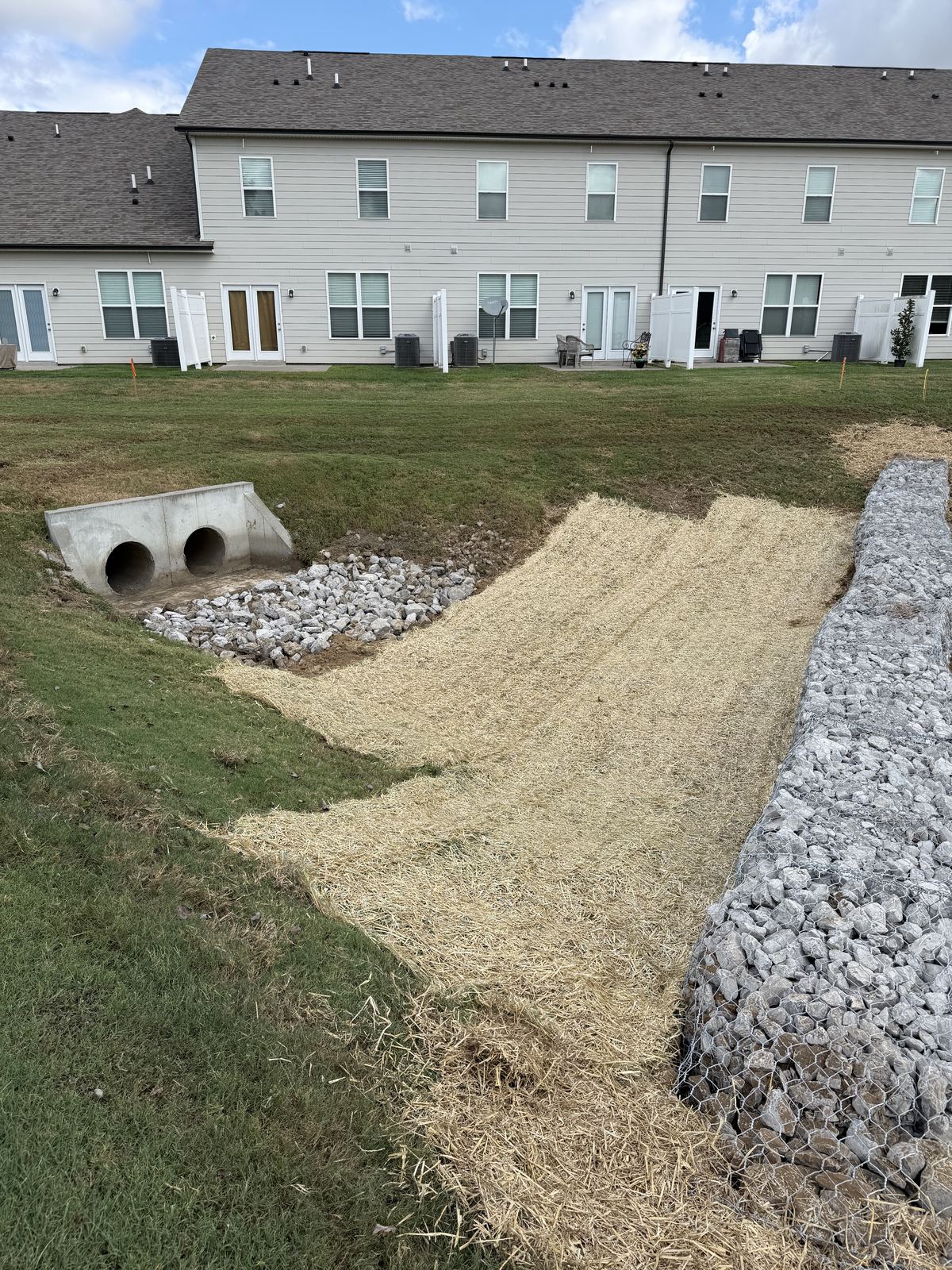
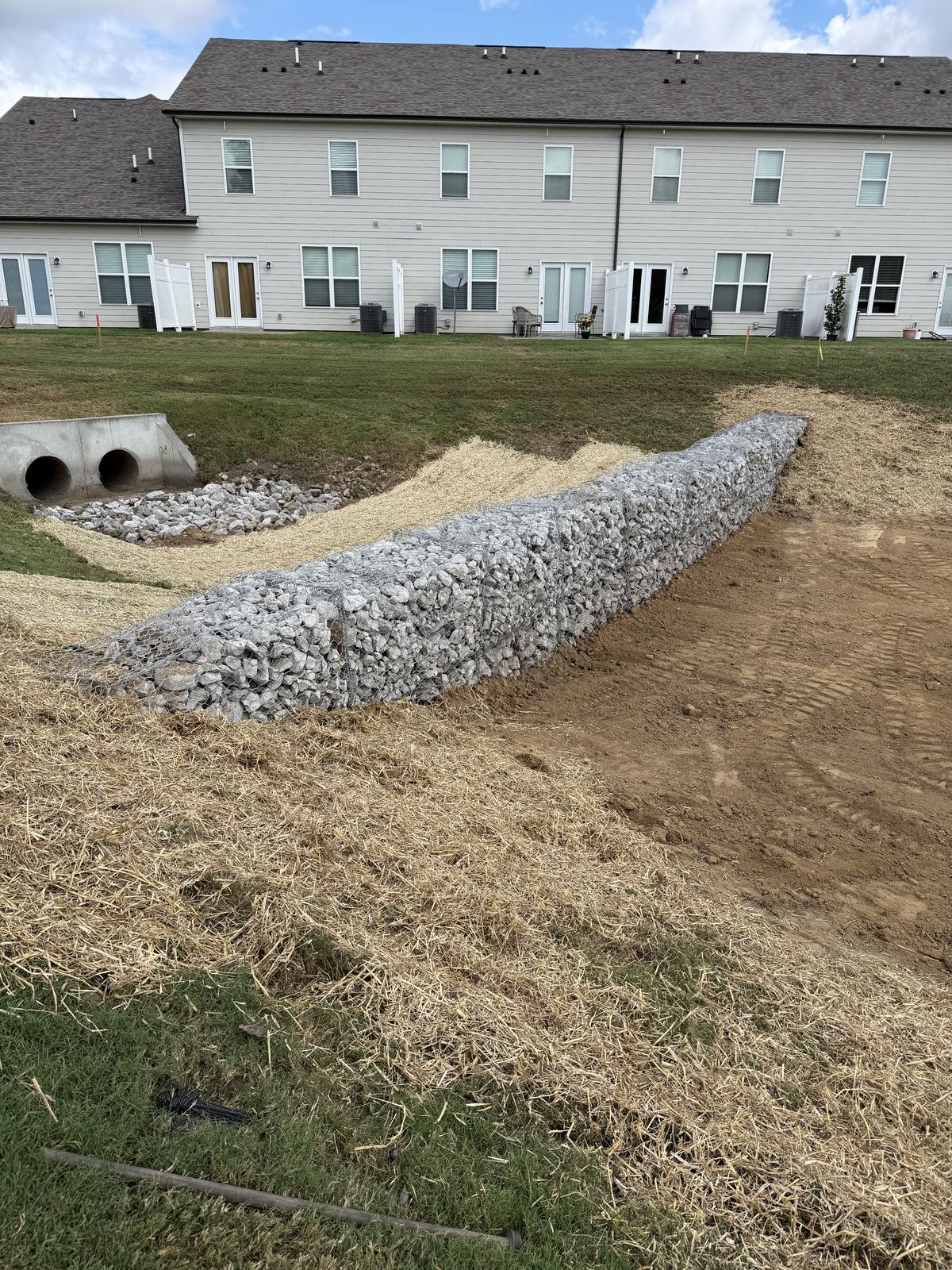
A forebay is a small cell at the point where stormwater enters a pond. Runoff coming off roofs, streets, and parking lots carries sediment. The forebay slows that water down and makes it drop the sediment right there at the inlet, instead of spreading it across the main pond and filling it in. When it needs cleaning out, it's one small area instead of the whole pond.
Gabion baskets are a good fit for the job: the stone-filled cages are heavy enough to stay put when the pipes are running hard, they let water pass through slowly rather than overtopping all at once, and they hold their shape year after year. Paired with rip rap on the channel below the pipes, the inlet can take a hard rain without scouring out.
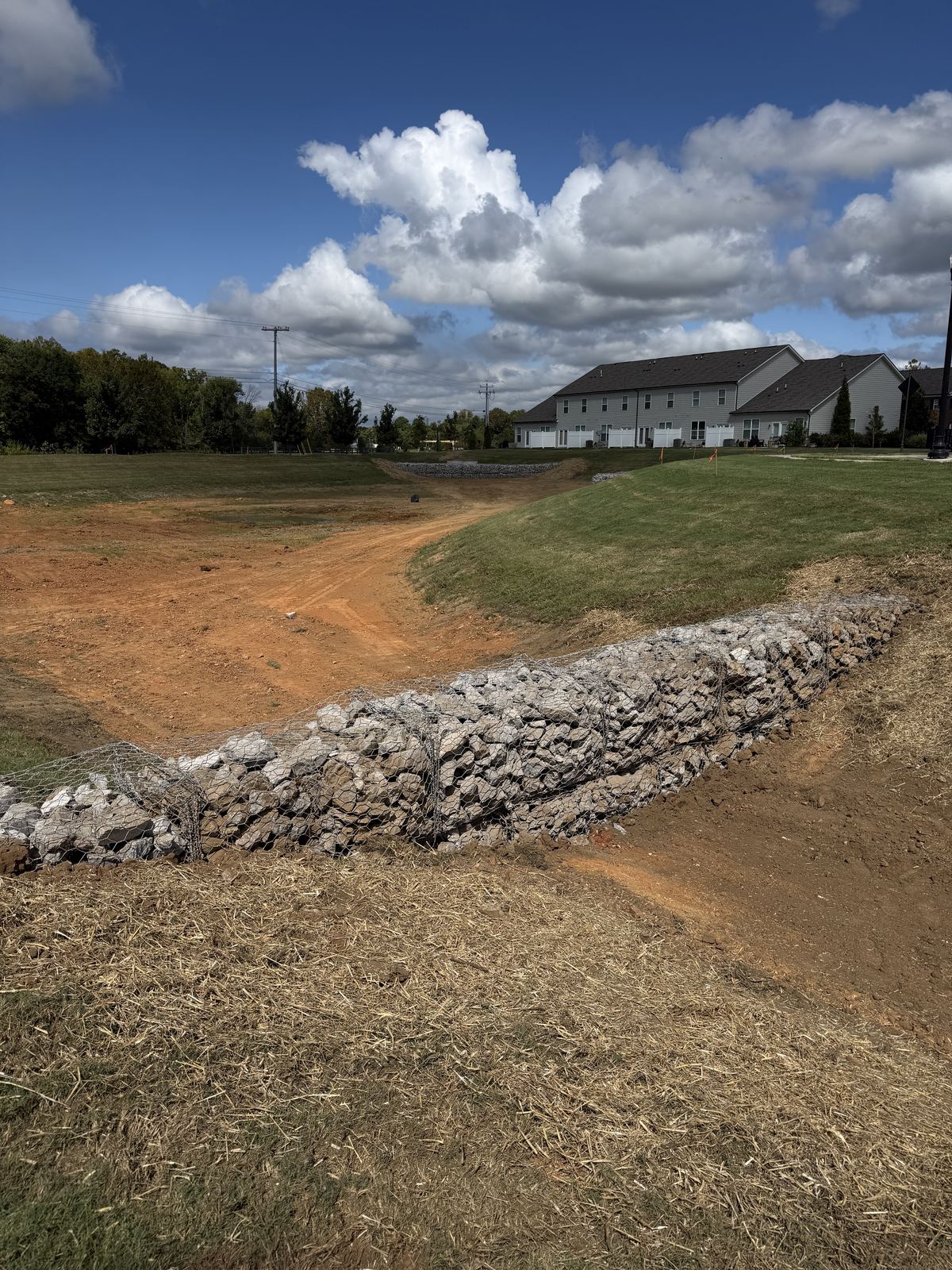
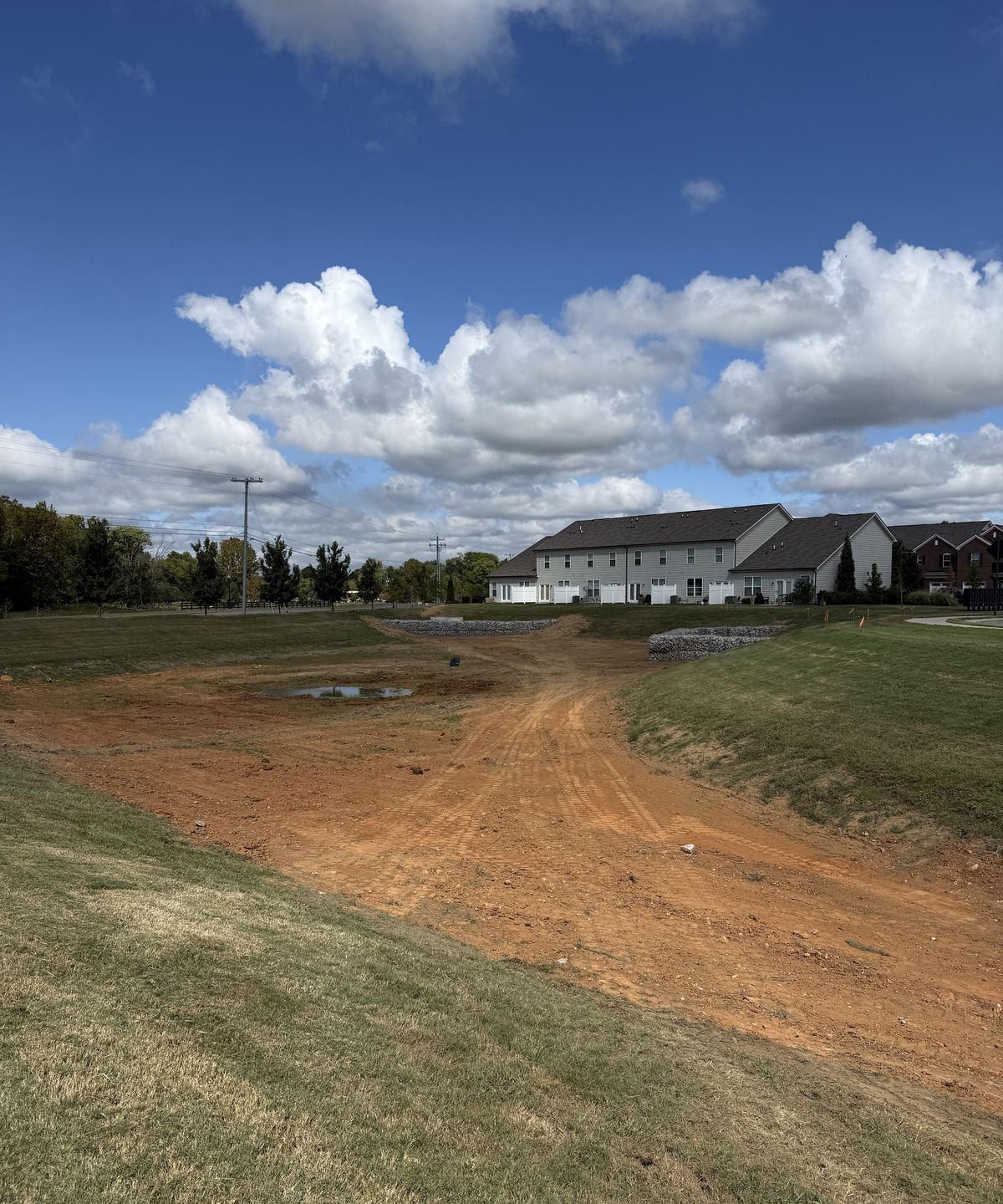
The leaking bottom is gone, the rock that was bleeding water is out, and the pond is rebuilt on red dirt. Three gabion basket forebays meet the city's requirement and will catch sediment at the inlets for years, and the disturbed banks are seeded and strawed. This is the kind of job that has to be done all the way down — a surface patch on a rock bottom just leaks again.
Ponds that won't hold water, detention and retention ponds that need forebays or outlet work, silted-in ponds, and inlets washing out — we handle the excavation, the rock, the rebuild, and the stonework, and we can build to the city's or engineer's requirements. See also our rock removal & excavation and erosion control work, and the riprap channel project.
We work Lebanon, Mount Juliet, and the rest of Wilson County, along with Hendersonville, Gallatin, Goodlettsville, Millersville, and throughout Middle Tennessee.
Pond repair, forebays, gabion baskets & rip rap — free estimates, straight quotes.